- info@tacticalroofing.co.nz
- Glen: 022 645 0775
-
Opening Hours: Weekdays 08:00 - 17:00

If your home sits close to the water, on a ridge, or in an exposed Auckland suburb, your roof works harder than most. It is not just rain that causes problems. Salt-laden air accelerates corrosion. Strong wind pressure lifts edges and stresses fixings. Poor drainage traps debris and speeds up wear.
Choosing the right roofing solutions from the start makes a real difference to how long your roof lasts and what it costs you over time. That means understanding what exposed Auckland homes actually face, which materials and installation details hold up best, and when to call roofing specialists or a roofing contractor for the right next step.
Salt particles settle on roof surfaces and work into fixings, lap joints, and cut edges. Over time, this accelerates the breakdown of protective coatings and speeds up rust wherever the finish has been scratched or where water pools.
Homes within a few kilometres of the coast, Herne Bay, Devonport, or anywhere along the Manukau Harbour, face this constantly. The closer you are to the water, the more demanding the environment.
Wind creates uplift pressure at the eaves, ridges, and corners. This is exactly where roofing sheets are most likely to lift if fixings are undersized, incorrectly spaced, or worn.
In high-wind zones, this pressure can pull fasteners through aged panels or cause work flashings to be pulled away from walls and penetrations. What looks like a minor edge flap after a storm can open a water entry point that reaches the ceiling lining within days.
Resilience in roofing comes from both design and material choices. A low-pitch roof that drains slowly, internal gutters that trap debris, or a corrugated profile without the right underlay will underperform in exposed settings regardless of the sheet material. Coastal and high-wind Auckland homes need roofing solutions that consider exposure zone, pitch, profile, fixings, and drainage together.
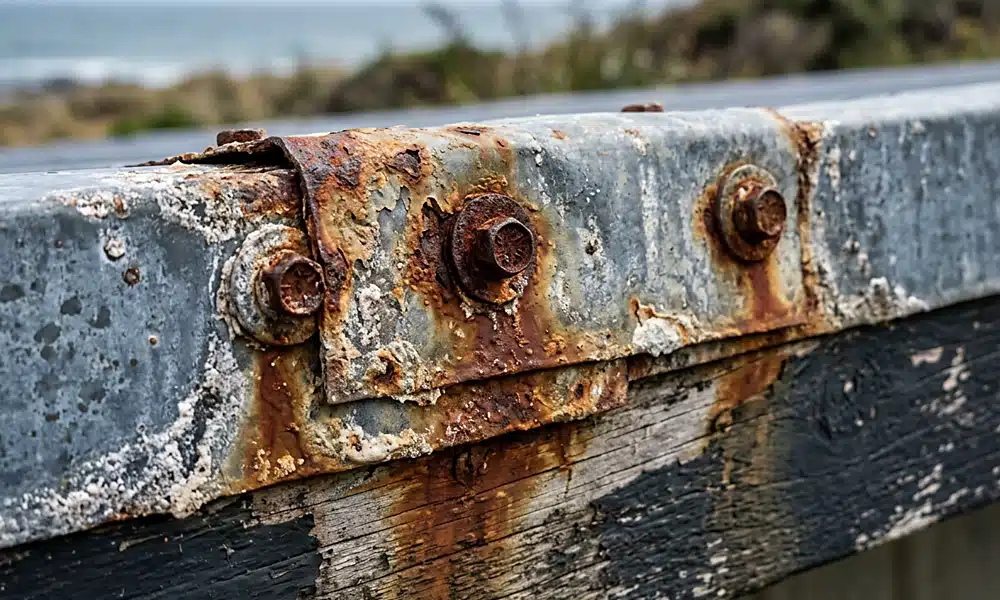
Salt air degrades protective coatings gradually. The first signs are often subtle. Discolouration along a lap joint, surface pitting near the ridge, or rust staining around a fastener head. Left unchecked, corrosion can quickly penetrate the base metal.
Fasteners work loose over the years of wind cycling. Ridge caps, valley irons, and roof-to-wall flashings are particularly vulnerable because they sit at transition points where wind pressure peaks.
Most Auckland roof leaks do not come from the middle of a sheet. They start at edges, usually around skylights, pipes, chimneys, and flashings where two surfaces meet. Sealants dry out, flashings separate, and water finds the path of least resistance into the structure below.
When water backs up behind clogged gutters or valleys, it sits against roofing materials and accelerates wear. Our project work has included re-pitching roofs from 1.5 degrees to 3 degrees and converting internal gutters to external box guttering.
This is a practical fix that dramatically improves drainage and removes the trapped-water problem that internal systems create in exposed settings.
Long-run metal roofing is the most widely used and well-suited roofing solution for exposed Auckland homes. It handles high rainfall and resists UV degradation. Also, when specified with the right coating and substrate, they perform well in coastal conditions. Fewer joins mean fewer potential leak points.
Standing seam profiles like the Espan 340, which we have installed on projects in Herne Bay, use concealed fixings rather than exposed fasteners through the sheet face. This removes the most common point of water ingress and wind-stress failure from the equation. For exposed coastal and high-wind locations, this profile is one of the strongest-performing roofing solutions available.
Older character homes and villas may suit stone-coated or pressed metal profiles that match the original appearance while offering improved weather performance. These systems are heavier and require correct structural support, but they work well where heritage character matters and the roof structure can carry the load.

A quality sheet installed over an inadequate underlay or poorly fitted flashings will still let water in. In exposed settings, underlay needs to manage condensation, provide a secondary water barrier, and cope with wind-driven rain. Flashings at ridges, hips, valleys, and wall junctions need to be correctly lapped, sealed, and fixed to prevent uplift.
Fixing spacing, fastener type, and whether fixings are exposed or concealed all affect how well a roof handles wind load. In high-wind zones, closer fixing centres and heavier-gauge fasteners are often required to meet New Zealand Building Code performance expectations. Using the wrong fixings is one of the most common sources of roofing failure in Auckland’s exposed suburbs.
Undersized or poorly sloped gutters cause water to back up against the eaves and into wall cavities. External box guttering, properly sized and sloped to the outlet, prevents this. In coastal areas, gutters need to be cleared more often because salt and organic debris accumulate faster.
A thorough inspection goes beyond visible rust and blocked gutters. The current fixing condition, flashing integrity, underlay performance, ridge cap adhesion, and valley drainage all get checked. We start every job with a careful assessment and give honest feedback and clear recommendations, not just a list of billable work. Roofing specialists also factor in distance from the coast, prevailing wind direction, and roof pitch when assessing what the property actually needs.
If the structure is sound and the problem is localised, targeted roof repairs are often the right call. If leaks keep returning, rust is widespread, or the roof is 20–30 years old, re-roofing usually delivers better value than continued patch-ups.
After any significant Auckland weather event, check for lifted ridge caps, separated flashings, debris in valleys, and new water marks on interior ceilings. These are the most common post-storm entry points, and catching them early limits the damage.
A small rust patch near a fastener, a slightly lifted flashing edge, or a gutter pulling away from the fascia. But each is a path for water to enter, and water in a roof structure moves laterally before it drips. Calling roof repair specialists early is consistently cheaper than waiting until the damage spreads.
When a roof is actively leaking, the priority is limiting damage to the structure, insulation, and lining below. We at Tactical Roofing can put temporary fixes in place during heavy rain to stop further water entry until conditions are safe for the full repair. This protects the home without rushing structural work in dangerous weather.
Repairs make sense when the roof is under 20 years old, the material is in reasonable overall condition, and the problem is clearly localised. A failed flashing or a cracked tile on an otherwise sound roof does not justify full replacement.
The signals that point toward re-roofing are consistent: leaks that return after repairs, widespread corrosion, sagging sections, age of 20–30 years or more, or a worn appearance that maintenance will not reverse. At that point, continued repairs become a false economy. A qualified roofing contractor with Auckland experience can put numbers around both options so you can compare cost and risk before committing.
Tactical Roofing provides obligation-free quotes across all four services. Call Glen on 022 645 0775 or book a free quote today.
These questions quickly separate those who understand exposed Auckland conditions from those using a one-size-fits-all approach.
Our process runs from consultation through to final inspection. There should be a clear proposal, quality installation that minimises noise and disruption to the household, and a walkthrough before the job is signed off. With over 25 years of experience working on Auckland homes, the expectation is straightforward: quality work, on time, within budget, no surprises on the invoice.
For most Auckland homes, a professional inspection every 12 to 24 months is the right baseline. Coastal properties benefit from sitting closer to the 12-month end of that range. After any significant storm, a ground-level visual check is worthwhile regardless of when the last visit was.
Between inspections, clear gutters and downpipes at least twice a year, check valley drainage, and monitor flashing junctions for sealant breakdown or separation. A roof maintenance visit from Tactical Roofing covers inspection, cleaning, resealing, flashing checks, and any small repairs identified on the day, all in one call. For exposed Auckland homes, preventative maintenance is not optional. It is the most cost-effective part of the whole roofing plan.
Long-run metal roofing with concealed fixings and the right corrosion-resistant coating performs well in most coastal settings. Profile choice, fixing specification, and flashing detail all affect the outcome as much as the sheet material itself.
Any time the work involves weathertightness or compliance with the New Zealand Building Code, you need a Licensed Building Practitioner. Structural or weathertightness issues need qualified roofing professionals.
Flashings, fixings, and drainage points. Most Auckland roof leaks trace back to a transition or penetration, not the middle of a sheet. Roof repair specialists follow the water path back to its source before scoping the repair.
Yes, when correctly specified and installed. Long-run metal roofing with appropriate fixing centres, the right underlay, and well-fitted flashings is one of the most wind-resistant roofing solutions available in New Zealand.
© 2026 |Tactical Roofing | All Rights Reserved | Designed by 